Wei-Cheng Wang
Wei-Cheng Wang 王偉丞

Ph.D.
Identifying where lab-validated ML breaks in the field.

Based in Taiwan.
Open to AS / RE roles, interviews available now.

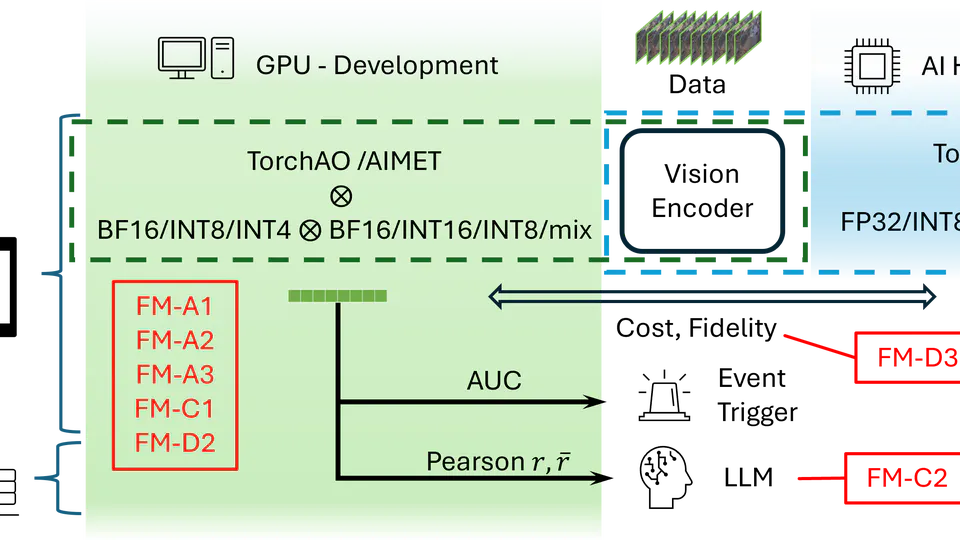
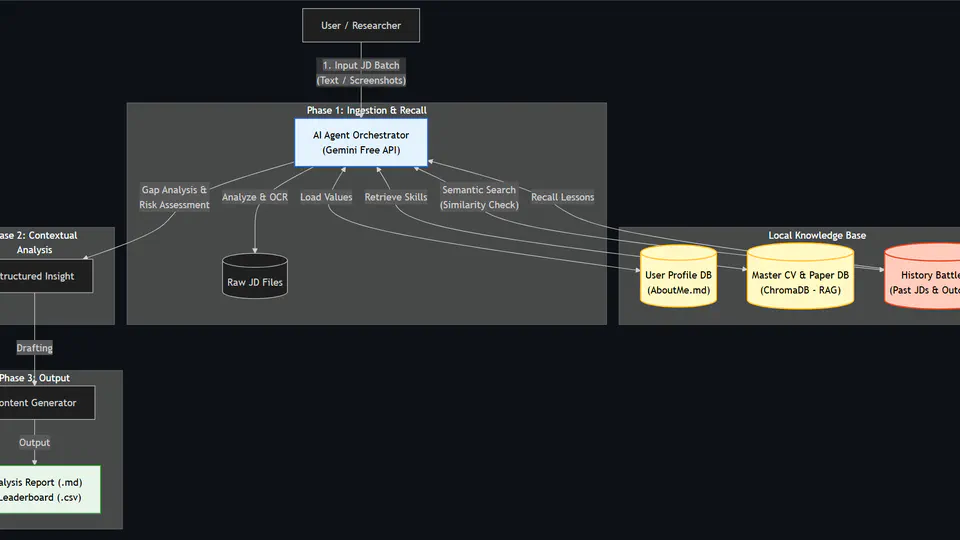
I am currently working on edge-cloud VLMs, quantizing the vision encoder for on-device deployment on a Qualcomm NPU, with a manuscript in preparation on where evaluation breaks between development and deployment. In parallel, I am extending my PhD research line into synthetic data generation for cross-environment ML transfer and explainable AI; a Google TPU Research Cloud proposal is under review. To validate the orchestration pattern for that work, I built a cost-efficient multi-agent LLM pipeline as a PoC.

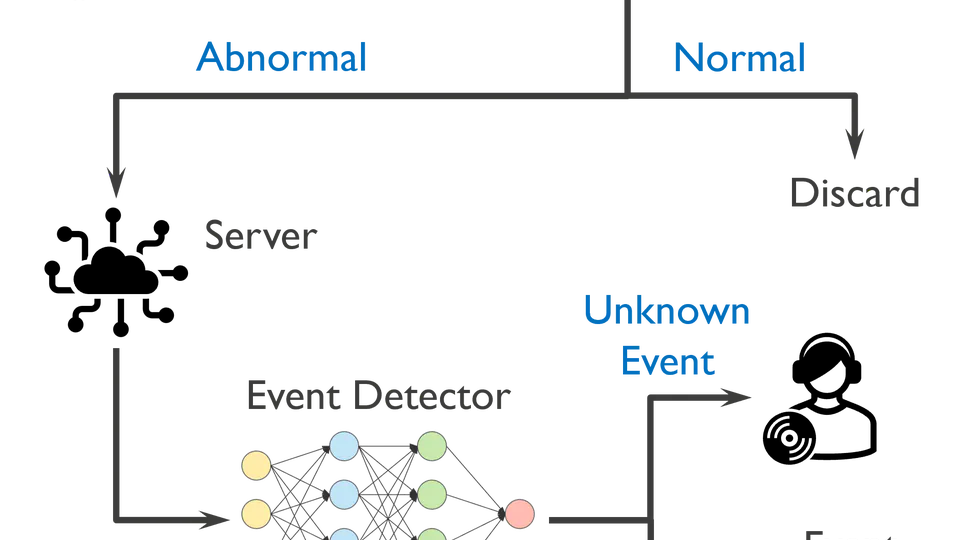
In 2025, I completed my Ph.D. at Ghent University-imec, and was previously a RA at Academia Sinica. Both my PhD and MSc research were conducted on real-world data, covering 5000+ hours of uncurated audio streams and extended video across multiple deployment sites.

My research focuses on building solutions at the mechanism-level while under real-world constraints. Recognition includes 13 peer-reviewed articles (7 journals, ICIP oral), 150+ citations, APICTA award, and Top 3% master’s graduate honor.

Download CV
Interests
  • Deep Learning
  • Computer Vision
  • Audio Privacy
Education
  • PhD in Computer Science Engineering

    Ghent University, Belgium

  • MSc in Computer and Communication Engineering

    National Cheng Kung University, Taiwan

  • BSc in Electrical Engineering

    National Cheng Kung University, Taiwan

Recent Activities
  • 2026 to now

    ResearchEdge-Cloud VLM: vision encoder quantization for on-device deployment

    Quantizing a VLM vision encoder for a Qualcomm QCS8550 NPU. Eleven configurations evaluated on GPU, four actually executable on target. The paper is about where evaluation breaks between development and deployment. Manuscript to be submitted.

  • 2026.06

    ProposalGoogle TPU Research Cloud proposal, under review

    Reality-Bounded Synthetic Data via Decoupling and Recombination: extending the PhD line to cross-environment event and behaviour transfer, and person-level stress-testing for deepfake detection.

  • 2026.01

    BuildMulti-agent LLM orchestration PoC

    Cost-efficient routing, context isolation, and model gating, validated on a CPU/API-only setup before committing to GPU-heavy compute.

  • 2025.11

    MilestonePh.D. conferred by Ghent University-imec

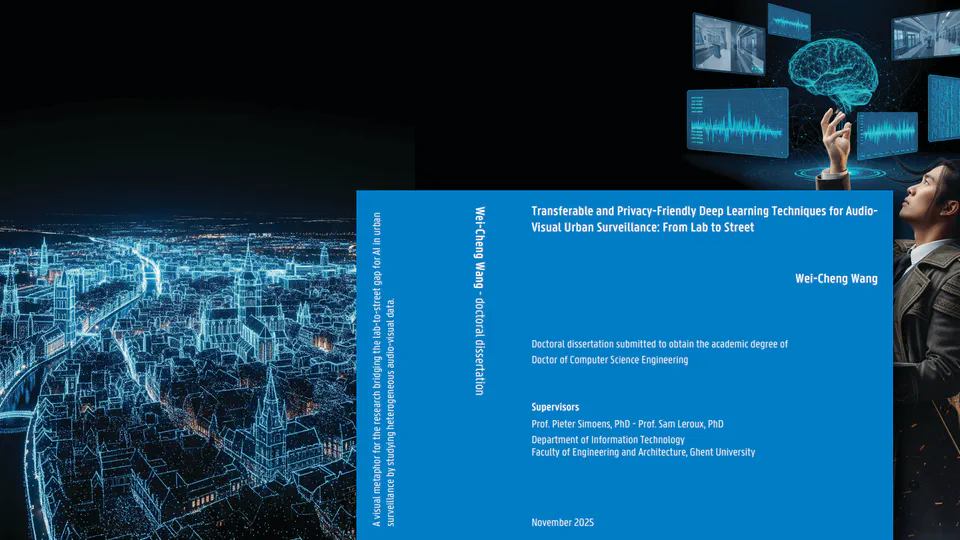
    From Lab to Street: transferable and privacy-friendly deep learning for urban surveillance, built on 5000+ hours of uncurated real-world audio.

  • 2025.06

    PaperSource-free model transferability assessment

    Published in MDPI Sensors: ranking model transferability for smart surveillance without access to source data.

  • 2025.01

    PaperEmbedding-based pair generation for contrastive learning

    Published in Frontiers in Robotics and AI: audio-visual representation learning on real surveillance streams.
Featured Projects
Publications
(2025). Embedding-based pair generation for contrastive representation learning in audio-visual surveillance data. Frontiers in Robotics & AI (Scopus Top 25%).
(2024). Privacy-preserving visual analysis: training video obfuscation models without sensitive labels. Applied Intelligence (Scopus Top 19%).
(2022). An Opt-in Framework for Privacy Protection in Audio-Based Applications. IEEE Pervasive Computing (Scopus Top 40%).
(2022). Selective manipulation of disentangled representations for privacy-aware facial image processing. In MLCS @ ECML PKDD 2022.
(2019). Driver Monitoring Using Sparse Representation With Part-Based Temporal Face Descriptors. IEEE T-ITS (Scopus Top 3%).
(2018). Clustering Trajectories in Heterogeneous Representations for Video Event Detection. IEEE ICIP 2018.
(2018). USEAQ: Ultra-Fast Superpixel Extraction via Adaptive Sampling From Quantized Regions. IEEE T-IP (Scopus Top 1%).
(2018). Spatiotemporal Coherence-Based Annotation Placement for Surveillance Videos. IEEE T-CSVT (Scopus Top 3%).
(2017). Event based surveillance video synopsis using trajectory kinematics descriptors. IAPR MVA 2017.
(2016). Trajectory clustering using affinity propagation with trajectory entropy descriptor. ICIAE 2016.
(2015). Video gender recognition using temporal coherent face descriptor. IEEE/ACIS SNPD 2015.
(2015). Trajectory kinematics descriptor for trajectory clustering in surveillance videos. IEEE ISCAS 2015.
Awards
Dual Master’s Thesis Award
The Chinese Image Processing and Pattern Society & The Chinese Institute of Electrical Engineering ∙ August 2016
My master’s thesis, Spatiotemporal Coherence based Annotation Placement for Surveillance Videos, received national recognition from two distinct professional societies. It was awarded the Best Master’s Thesis Award by the Chinese Image Processing and Pattern Society for its contributions to the field, and concurrently received the Excellent Master’s Thesis Award from the Chinese Institute of Electrical Engineering for its technical excellence.
Multiple International Awards
Asia Pacific ICT Alliance (APICTA) & International ICT Innovative Services Awards ∙ November 2015
As team leader, I led our project, Online Video Synopsis: Shorten Video Content for Flicking Through, to secure three major international awards in 2015. We achieved First Place (USD $17000 prize) for business potential and Second Place for innovation at the International ICT Innovative Services Awards. Concurrently, representing Taiwan as the national nominee, we won the Merit Award in the R&D category at the 17-economy Asia Pacific ICT Alliance (APICTA) Awards held in Sri Lanka.
International ICT Innovative Services Awards
International ICT Innovative Services Awards ∙ October 2015
Our project, Innovative Personal Driver Monitoring System, was recognized for its innovation in ICT applications, securing Second Place in its category at the International ICT Innovative Services Awards.