
Learn Python
Easily learn Python in 10 minutes!
Oct 24, 2023
SenseCity - Acoustic Surveillance in Real-World
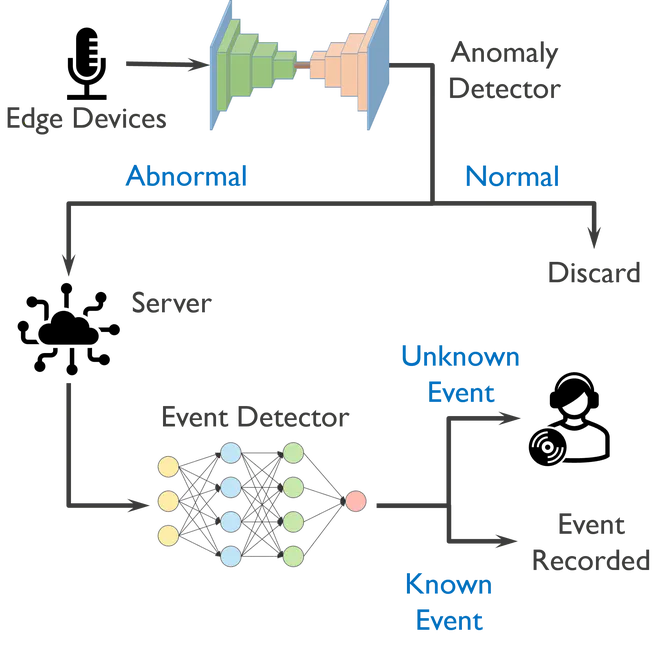
SenseCity x AsaSense: Critical Analysis of Urban Acoustic Surveillance A strategic research collaboration with the SenseCity project (AsaSense), utilizing city-scale raw acoustic data to expose the failure modes of standard surveillance models and proposing context-aware architectural solutions. The Research Gap & Motivation Why “Off-the-Shelf” Fails in the Wild: Most acoustic surveillance systems are validated on clean, curated datasets. However, their performance on raw, unprocessed urban audio remains largely unverified. Our Mission: In collaboration with AsaSense, we accessed a unique stream of continuous, uncurated audio from Ghent and Rotterdam. Instead of just deploying a standard model, our goal was to stress-test two dominant paradigms: anomaly detection and sound tagging, and identify why conventional paradigms fail in dynamic environments (e.g., temporal drift, open-set events), and propose robust alternatives. Operational Context (The SenseCity Testbed) This project leveraged a real-world infrastructure to diagnose algorithmic limitations: Raw Data Ingestion: Unlike academic datasets, the SenseCity sensor network captures the “messy” reality of cities across two years: wind noise, overlapping soundscapes, and non-stationary backgrounds. Most importantly, without any annotations. System Audit: We applied SOTA approaches on anomaly detection and sound tagging models to this raw stream. The analysis revealed that global models generate unmanageable false alarms due to contextual blindness (e.g., treating a weekend market as an anomaly because the model only knew weekday traffic), further causing operator fatigue and leading to system failure. Core Conclusion: Our experiments conclusively proved that a single global model is insufficient for city-scale deployment. Instead, Context-Specific Modeling (sensor-specific baselines) is a prerequisite for operational reliability. Proposed Resolution: Based on these findings, we formulated a Context-Aware Design Framework, advocating for sensor-specific baselines and adaptive thresholding to handle the inherent variance of city life. Core Methodologies Data Source: High-fidelity, long-term raw acoustic logs from the AsaSense deployment (Ghent & Rotterdam). Diagnosis Method: Cross-context evaluation (Spatial & Temporal Domain Shift). Algorithmic Focus: Unsupervised Deep Autoregressive Modeling (WaveNet) vs. Pre-trained Tagging Models. Architecture Design: Feasibility analysis of Hybrid Edge-Cloud pipelines to mitigate bandwidth bottlenecks. Technical Analysis & Innovations 1. Diagnosing the “Generalization Fallacy” The Problem: We demonstrated that state-of-the-art anomaly detectors suffer from severe concept drift. A model trained on “winter data” failed catastrophically during summer evenings due to changed human activity patterns. The Solution: Proposed a Context-Specific Modeling approach, proving that training lightweight, dedicated models for each sensor location significantly outperforms a massive, generic global model in anomaly retrieval. 2. The Limits of Semantic Tagging The Finding: Standard sound taggers (trained on AudioSet) struggle with the Open-Set Nature of cities. They force novel urban sounds into rigid, pre-defined categories, leading to semantic misalignment. The Proposal: Suggested moving from “rigid classification” to “unsupervised deviation detection” at the edge, using tagging only as a secondary enrichment layer in the cloud, rather than a primary filter. 3. Architectural Scalability (Edge vs. Cloud) Analysis: Analyzed the trade-off between transmission cost and detection latency. Recommendation: Proposed a “Filter-then-Forward” architecture where edge nodes perform lightweight unsupervised screening, transmitting only potential anomalies to the cloud. This reduces bandwidth consumption by orders of magnitude while preserving privacy. Outcomes & Impact Empirical Evidence: Provided one of the first comprehensive studies on the limitations of transfer learning in acoustic surveillance using real-world, longitudinal data. Design Guidelines: The findings established the foundation for Privacy-Preserved & Adaptive Surveillance, directly influencing the design of subsequent research on privacy in surveillance. Strategic Value: Delivered critical insights to the industrial partner (AsaSense) on avoiding “technical debt” by pivoting from global models to adaptive, edge-based learning. Resources Chapter 2: The AsaSense Project - Detailed analysis of deployment constraints and algorithmic failures.
Jun 30, 2021